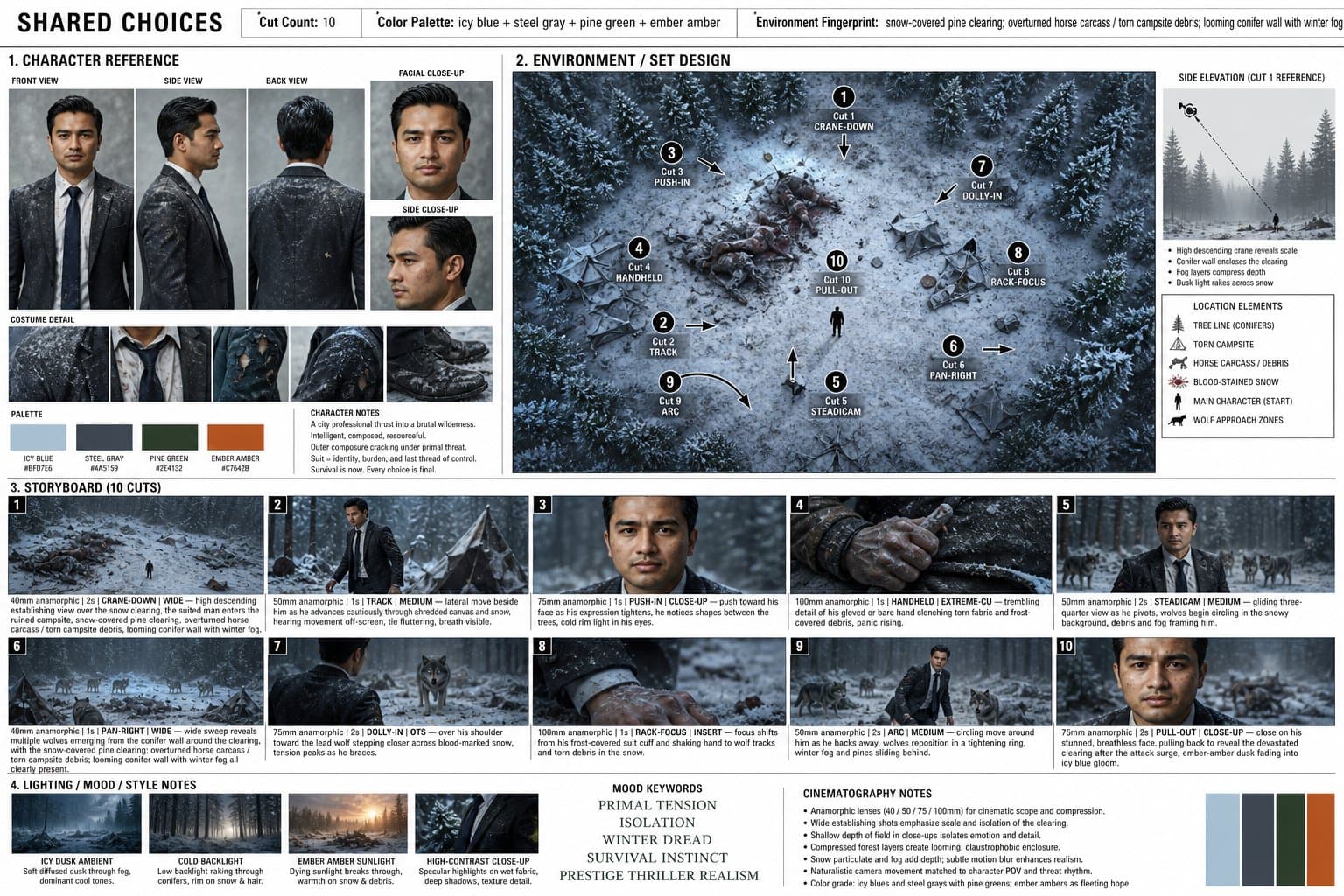
Create a premium winter survival storyboard presentation sheet for an original prestige thriller. The board should look like a professional film pre-production artifact, not a comic page.
Canvas: 3:2 horizontal master board with 10 cinematic panels, grayscale blueprint background, clean editorial spacing, icy blue and steel gray palette, pine green accents, ember amber highlights, shot numbers, and compact technical annotations.
Story: a stranded adult protagonist crossing a snow-covered pine forest, discovering traces of danger, building a fire, following footprints, facing a whiteout, and reaching a distant rescue signal. Keep the mood tense but avoid graphic violence.
Details: include wide establishing shot, close-up prop shot, low-angle panic shot, tracking movement panel, map insert, survival gear detail, and final hopeful frame. Add short English labels only.
Style: AI survival thriller storyboard prompt example, winter survival storyboard, cinematic pre-production sheet, film pitch board, icy wilderness tension, polished director treatment visual.
Negative prompt
gore, horror monster close-up, unreadable tiny notes, chaotic comic layout, random fantasy armor, modern city background, flat panels, low-detail snow scene
How to adapt this prompt
Turn the example into your own brief.
Replace the subject, product, place, or audience.Keep the composition and camera language, then swap the object, brand, city, or customer.Preserve lighting and material constraints.Reuse the lighting, texture, and finish details that make the image feel specific.Match the aspect ratio to the channel.Move between square, vertical, and wide crops based on ads, posts, covers, or landing pages.Tighten the negative prompt after review.Add exclusions for text errors, distorted objects, clutter, or style drift after the first result. What this prompt is good for
Winter Survival Thriller Storyboard is built for AI survival thriller storyboard prompt example for film pitch boards, video planning, and cinematic scene design.
Use this AI image prompt when you need a focused Editorial Visuals result with a clear style direction, a defined format, and enough visual constraints to avoid generic output.
- Best search intent: AI survival thriller storyboard prompt example, Winter survival storyboard, and Film pitch board
- Primary workflow: AI survival thriller storyboard prompt example for film pitch boards, video planning, and cinematic scene design
- Recommended output format: 3:2
Prompt breakdown
Key controls inside this Cinematic winter film storyboard prompt.
The prompt combines subject direction, lighting, composition, visual style, and output quality in one reusable brief. Keep those constraints together when you adapt it for your own image.
- Style anchor: Cinematic winter film storyboard
- Category context: Editorial Visuals
- Includes a negative prompt to reduce style drift, distorted details, and unwanted artifacts.
Best variations to try
Adapt this prompt without losing the original image logic.
Start by changing the subject, product, place, color palette, or audience. Keep the camera language and visual hierarchy stable until the result matches the page, ad, post, or campaign you are building.
- Swap the subject while keeping the 3:2 composition.
- Turn the style into a new campaign by changing colors, wardrobe, props, or location.
- Use the prefilled generator link to test the prompt, then refine one variable at a time.
Internal prompt paths
Explore more Editorial Visuals prompts.
Browse nearby workflows, compare prompt packs, or open the generator with this example already loaded.
Prompt FAQ
Common questions about this AI image prompt.
What can I create with the Winter Survival Thriller Storyboard prompt?
You can use it to create AI survival thriller storyboard prompt example for film pitch boards, video planning, and cinematic scene design in a Cinematic winter film storyboard style, with a recommended 3:2 aspect ratio and search-friendly image direction.
Can I edit this AI image prompt for another subject?
Yes. Replace the subject, product, place, audience, or brand details while preserving the lighting, composition, aspect ratio, and quality constraints that give the prompt its structure.
Which aspect ratio works best for this prompt?
This example is designed around a 3:2 aspect ratio. You can change it for another channel, but keep the framing and hierarchy consistent when moving to square, vertical, or wide formats.
Should I use the negative prompt?
Yes. The negative prompt helps reduce issues such as gore, horror monster close-up, unreadable tiny notes, chaotic comic layout, random fantasy armor, modern city background, flat panels, low-detail snow scene. Use it as a starting point and add exclusions after reviewing your first result.